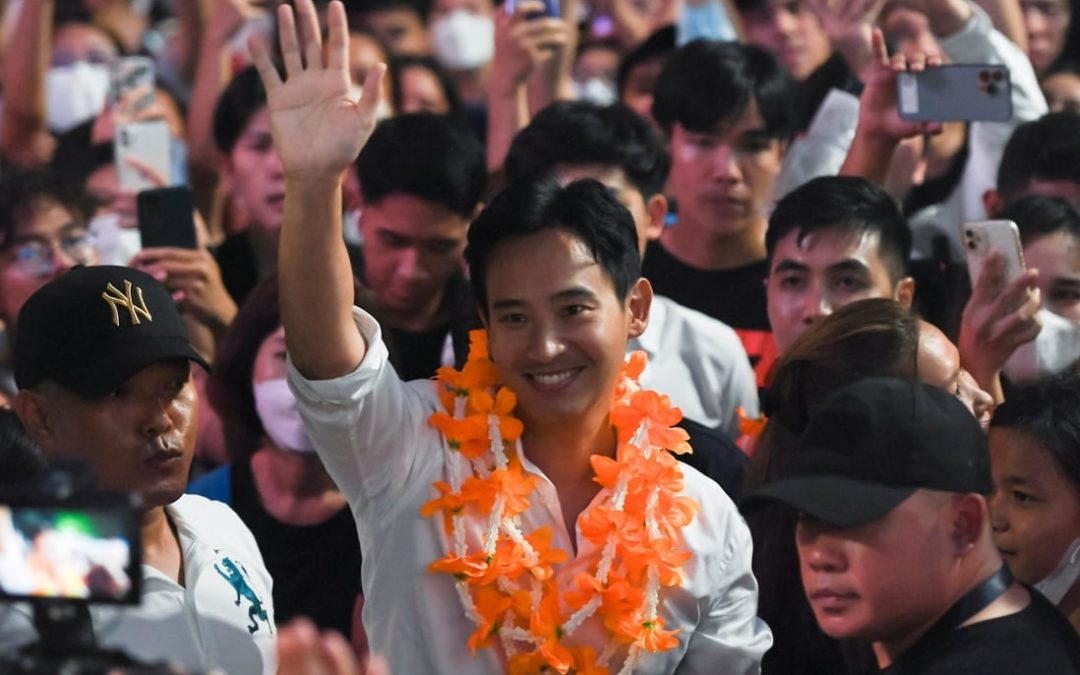
Defeat is a familiar feeling to the poor of Thailand. For those of us on the left, we have seen our movement repressed, our people jailed and killed en masse in the streets, our people disappeared one by one from their homes. Defeat is a familiar taste, a bitter taste, like traditional medicines from grandparents. The election result of the 8th of February 2026 was another defeat.
The ultra-right Bhumjaithai Party appears to have won a shocking near-landslide victory wildly exceeding all expectations. In our pre-election piece we described Bhumjaithai as “patronage disguised as politics. Its function is to protect agrarian inequality by neutralising class consciousness through elite alliances, performative welfare, ethnonationalist sentiment, and localised division.” The party’s ideology, while foundationally Thai nationalist, is akin to that of Bharatiya Janata Party (BJP) in India, or Erdogan’s AKP in Turkey. It is a familiar reactionary trap, one that despite its undemocratic nature, is dependent on parliamentary elections, a technique that has been increasingly developed across the Global South over the past two decades, a reactionary mode of class sterilisation, one extremely difficult to challenge.
Suspicions
However, in the case of Thailand, as well as the other examples listed above, this mode of reaction cannot function without the heavy hand of the elite classes. The election results in Thailand are suspicious to say the least. Going into yesterday’s general elections for the General Assembly (the lower house) Bhumjaithai was already under investigation for -fairly blatant- election rigging in the Senate (the upper house). While those charges are now likely to disappear it provides us with some context as to how the party increased its vote share by nearly 300% in 3 years.
At the time of writing on election morning, it is of course, very early days. However, as soon as polls closed and ballot boxes were opened last night rumours immediately began spreading about mass interference on behalf of Bhumjaithai, particularly in the outer provinces. Such practices are far from unheard of in the kingdom, and given Bhumjaithai’s alleged malfeasance in the Senate one need not stretch their imagination too far to understand how such a wild surge in voters was possible.
Imperial Boomerang
To be blunt Bhumjaithai are 21st century fascists. Deeply enmeshed in the military-monarchal-elite capitalist nexus which has governed Thailand ever since it became a Western proxy for America’s war on communism in Southeast Asia. Indeed, it is in this imperial assault that we find the party’s origins. In recent years Aimé Césaire’s term Imperial Boomerang has become increasingly utilized worldwide- originally used to describe how the turn to fascism in 1930s Europe was the application of colonialist procedures previously reserved for non-European peoples turned and applied back onto the European core.
In the case of Bhumjaithai, their heartlands, base and founding region has been the murky stretch of border between Thailand and Cambodia, one of the epicenters of colonial interference in cold-war geo-politics. The frontline from which The West armed, trained and supported the Khmer Rogue in their war against the Vietnamese backed Socialist project in Cambodia that was tentatively built following the Khmer Rogue’s genocide rule.
The specific military unit posted on this stretch of the border is known as the Eastern Tigers (21st Infantry Regiment), a unit originally founded by the US as an elite anti-communist proxy trained for both offensive and so-called ‘defensive’ warfare. Further developed by the US military in the 1950s–60s as a counterinsurgency division, the Eastern Tigers saw combat in Korea and Vietnam, as well as in domestic operations against leftist movements engaging in unspeakable horrors in neighbouring Laos and Cambodia.
Following the Vietnamese liberation of Cambodia in 1979, the regiment played a key role in supporting the Khmer Rouge insurgency along the border. From their strategic position, they facilitated large-scale trafficking operations, smuggling weapons, looted antiquities, drugs, and even people, consolidating both power and profit. It facilitated the movement of Cambodian refugees who were filtered through the border into the hyper-exploitation of the subaltern labour class of the urban core of Bangkok.
While the violence of the border was legendary, it also served as a kind of testing ground. Akin to theories of “The Gaza Laboratory” which posits that the Gaza Strip serves as a real-world testing ground for Israel’s military, surveillance and social engineering. Such technologies and modes of exploitation are tested on the Palestinian population, or in Thailand’s case the subaltern Cambodian population in the region, before being imported to the domestic core.
By the late 2000s, the Eastern Tigers regiment had grown into the most dominant military faction within Thailand’s already heavily militarised political landscape. Their power was solidified in 2014, when they orchestrated the coup that overthrew left-populist Red Shirt PM Yingluck Shinawatra’s Pheu Thai government. Appointing Eastern Tigers General Prayut Chan-o-cha as Prime Minister. In 2018 the military officers who had taken part in the coup removed their uniforms and took the role of civilians. In this faux-civilian phase, Bhumjaithai, who at the time were a minor party, were invited in as civilian coalition partners, providing party leader and future Prime Minister Anutin Charnvirakul with his first ever cabinet position.
Military to Civilian
After around a decade of military rule, elections were held, and Bhumjaithai emerged from the Thai-Cambodia border provinces as the key rising force in reactionary parliamentary politics. The party itself must be viewed as a component of Thailand’s broader reactionary state apparatuses. Its leadership are trusted enforcers within the establishment’s existing patronage system. Their control of the Interior Ministries (2019–2025) vast bureaucratic machinery; provincial governors, district offices, and local administrative networks, allowed the party to consolidate rural patronage systems they had honed in the border provinces, while keeping them subordinate to deep state power. Budget allocations, infrastructure projects, and bureaucratic appointments became tools of a larger strategy to pre-empt any leftist mass mobilisation of their largely rural base.
Through networks of landowning village elites, provincial business magnates, and local power brokers, Bhumjaitai was able to embed itself within Thailand’s traditional structures of control. This is a symbiotic relationship, whereby the village landowner provide Bhumjaitai with their local voter base and Bhumjaitai serves their interests at the national level, acting as their representative in Bangkok while ensuring their continued political dominance in the region. It is also no coincidence that their rapid rise to supposed popularity happened to coincide with a border war with Cambodia started and fought by the Eastern Tigers. It also should be considered, if one were interested in rigging an election, how useful it would be to have a vast network of village elites on the ground- hypothetically speaking of course. At the time of writing Bhumjaithai appear to have enough MP’s to comfortably form a coalition government with a clutch of other MP’s from some of the smaller ultra-reactionary parties.
Defeat
Defeat is a familiar feeling to the poor of Thailand, but it is not a death. For the past two decades, much of the political efforts of the poor have been invested in the agrarian populist Phue Thai party, who seemed to massively underperform in this latest election. Phue Thai politicians and supporters have historically been met with deadly state violence, disappearances, repression, open and public mass killings, but despite their leaders being increasingly shut out of these power networks they have always managed to bounce back. So too in years past, has the radical peasants movement, the slum workers movement, the Communist Party and countless peasant uprising stretching back centuries, been able to keep the fire burning, to win victories, to keep the aspirations of the poor alive.
While this election is undoubtedly a defeat for the poor, it is not a deathblow, just another hurdle that will be overcome. If anything, the abnormalities in voting count and clear indications of election rigging, shows us the weakness of the elite and the depth of strength of the masses. As one redshirt friend put it last night “We cried for 5 minutes and laughed for 5 hours.”